Golf Travel
  Leaderboards
  Become a Member
  Shop
Shop  Trade In
 Beginner
4 Ways to Score Better, Inspired by the U.S. Women’s Open
By Brendon Elliott, PGA
Published on

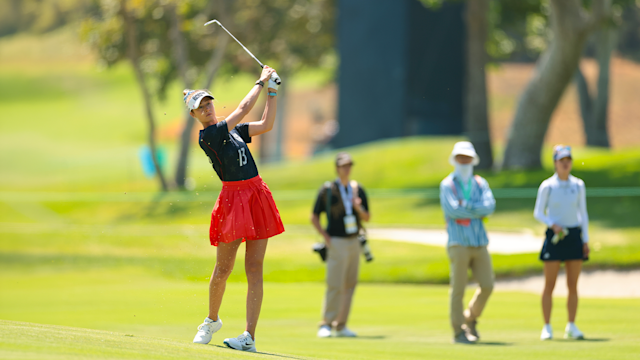
Through 36 holes at the U.S. Women’s Open Presented by Ally, Riviera Country Club has done exactly what a championship course is supposed to do.
It has made the world's best players think.
The field scoring average through two rounds was over par on the par-71 layout, which tells you something important. This has not been a week where players can simply chase every flag, swing freely at every driver and expect birdies to pile up. Riviera has rewarded discipline, patience, smart targets and the ability to recover when things go sideways.
That is where the average golfer can learn a lot.
You do not need to copy a U.S. Women’s Open swing to improve. You can copy the decision-making. Here are four lessons from the field-level stats at Riviera that can help you score better the next time you play.
Use Distance With A Plan
One of the first things that stands out in the stat hub is how much speed and distance exists in the modern women’s game. There are players out there carrying serious power and creating big advantages off the tee.
But here is the catch: Riviera is still playing over par.
That should tell every recreational golfer something. Distance matters, but playable distance matters more.
Before you automatically pull driver, ask yourself: “Where can I miss this and still play the hole?”
That one question can save you strokes.
If the fairway is wide, driver may be the right play. If the landing area pinches, if there is penalty trouble on one side or if your normal miss brings a punch-out into play, a 3-wood, hybrid, or long iron may give you a better chance to make par or bogey.
The goal is not to be cautious. The goal is to be committed. Pick the club that lets you make a confident swing and keeps your worst shot in play.
Aim At The Smart Target, Not Always The Flag
Strokes gained approach is one of the most important categories in elite golf because approach shots separate players quickly. At Riviera, that separation is easy to see. The greens are angled, protected and demanding.
Average golfers often get in trouble because they aim at every flag.
That is not how good players think.
Before an approach shot, identify three things: the flag, the center of the green and the best miss. The flag is the aggressive target. The center of the green is the smart target. The best miss is your backup plan.
If the pin is tucked near a bunker, water, a steep slope or thick rough, the center of the green may be your best target. A 30-foot putt is usually better than a short-sided chip from a tough lie.
Here is a simple rule: If you cannot comfortably carry the trouble or stop the ball near the flag, aim away from the trouble. That is not giving up. That is playing golf with a plan.
Make Your Short Game Simple
Riviera’s firm greens and tricky surrounds have put a premium on around-the-green play. When greens are missed, the players who can control contact, landing spot and speed are saving valuable shots.
For the average golfer, the short game can get too fancy.
You do not need five different specialty shots around the green. You need one simple shot you trust under pressure.
Pick a club that gets the ball on the green quickly and rolling like a putt. For many players, that might be a pitching wedge, gap wedge or sand wedge with a simple, brushing motion. Your first goal is not to hit the perfect shot. Your first goal is to get the ball on the putting surface.
Try this practice game:
Drop five balls just off the green. Pick one landing spot. Your goal is to land every ball near that spot and finish each shot inside a two-putt range.
That is how you build a short game that lowers scores. Simple contact. Predictable landing spot. Better speed.
Control Speed On The Greens
Putting stats always matter in a major championship, but at Riviera they matter even more because the greens have slope, pace and subtle breaks. The best putters are not just making putts. They are controlling the ball when they miss.
That is a huge lesson for everyday golfers.
Most players spend too much time trying to read the perfect line and not enough time working on speed. Line matters, but speed determines whether your next putt is easy or stressful.
If you want to putt better, practice from longer distances. Hit putts from 20, 30 and 40 feet and try to finish every ball inside a three-foot circle. Do not judge success by whether the putt goes in. Judge it by whether your next putt is makeable.
That is how you avoid three-putts. That is also how you take pressure off your entire game.
The Big Lesson From Riviera
The U.S. Women’s Open is showing us that great golf is not always about being aggressive. It is about knowing when to attack, when to play away from trouble and when to accept a smart miss.
That works at Riviera.
It also works at your home course.
The next time you play, do not just ask, “How many birdies can I make?” Ask, “How many big numbers can I avoid?”
That is championship thinking.
And it can help every golfer score better.
PGA of America Golf Professional Brendon Elliott is an award-winning coach and golf writer. Read his recent “The Starter” on R.org and his stories on Athlon Sports. To stay updated on his latest work, sign up for his newsletter and visit OneMoreRollGolf.com.