Golf Travel
  Leaderboards
  Become a Member
  Shop
Shop  Trade In
 Category - Amateur Programs
New Champions Emerge at PING USDGA Championship
By Craig Dolch
Published on
Carson Lane was just hoping to win his category in Wednesday’s final round of the PING USDGA Championship presented by PGA of America.
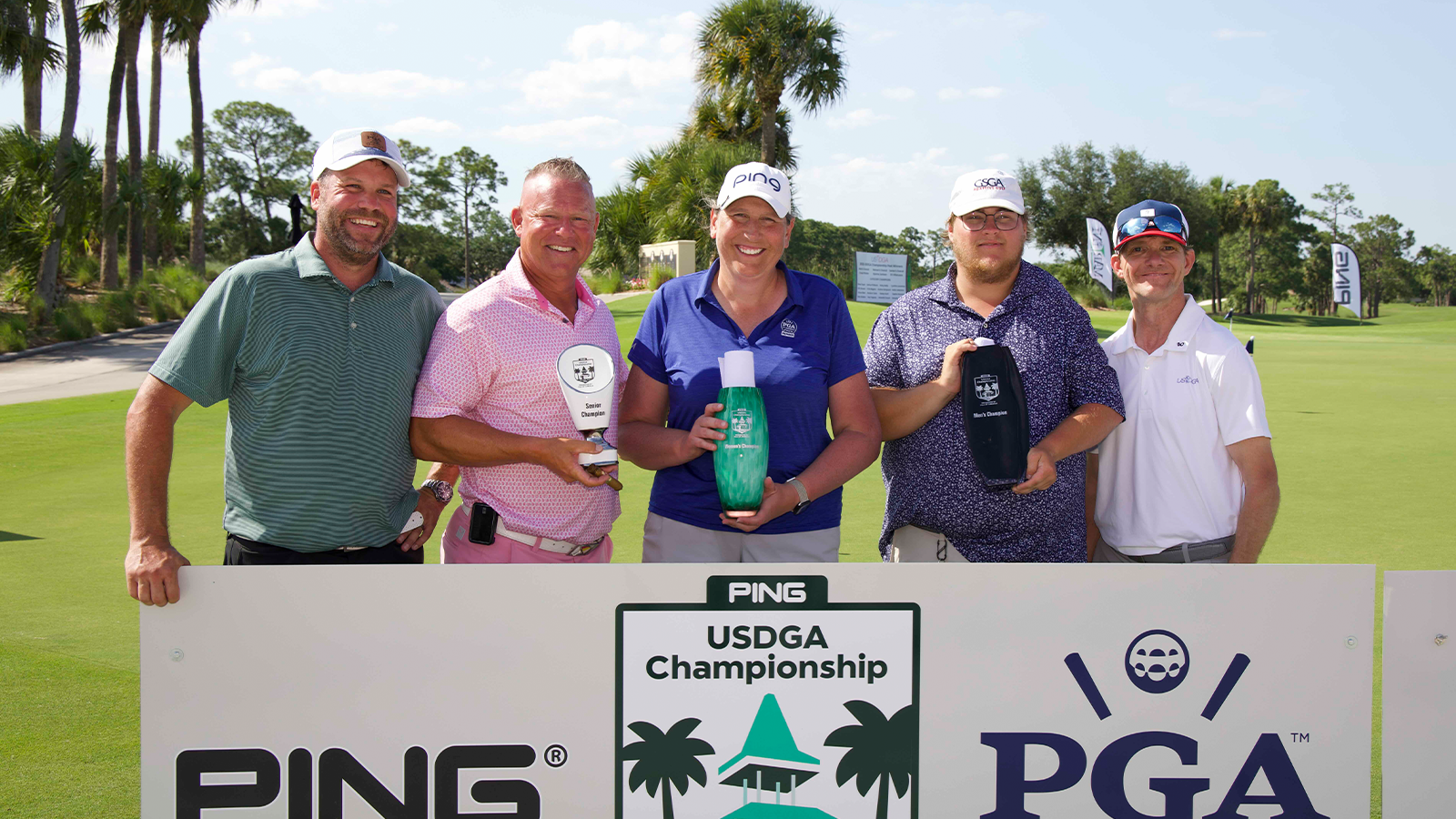
He instead walked away with the men’s overall title, winning with a par on the fourth playoff hole, preventing Chad Pfeifer from winning his fourth consecutive title.
David had beaten Goliath.
“I didn’t expect this,” an emotional Lane said. “I didn’t start playing golf until I played adaptive golf. From what I’m hearing, he’s a legend. It was awesome to duke it out with him.”
Pfeifer (71) appeared to be in control on the back nine before Lane (67) made four consecutive birdies, starting at the 11th hole, and Pfeifer had two late bogeys to force the playoff after both finished at even-par 213 on the Ryder Course at PGA Golf Club.
“I felt like it was kind of mine to lose,” said Pfeifer, who lost his left leg above the knee in 2007 while serving as an Army Specialist in Iraq. “I made a poor swing on the tee box at 16, and one bad swing can really change it. I then missed a short birdie at 17 that probably would have won it for me.”
Pfeifer said he had never met Lane, a 22-year-old from Bloomingdale, Ga., who has a brachial plexus injury that tore the nerves apart in his left shoulder, until the playoff.
Everyone in the adaptive golf world knows Lane now. His 67 was his career best by three strokes.
“I was just trying to make a run in the G5 category (one arm impairment) and I somehow made a run at the whole thing,” Lane said. “After the first playoff hole, my nerves weren’t as bad, so it was just copy and paste.”
Kim Moore of Fort Wayne, Ind., won the women’s overall division by eight strokes over Amanda Cunha of Hawaii. Moore shot 5-over 76 to finish at 18-over 231. Moore has won a pair of U.S. Adaptive Opens, but was playing in her first USGDA Championship.
Moore played her first hole in a combined seven-over for the three days, but was 12 over on the other 51 holes.
“I definitely did not have my best this week, but being able to scrounge around and get some decent scores says a lot,” said Moore, who was born without a right foot and a slight case of spina bifida.
“It’s an honor to win. It’s humbling. This (adaptive) community is such a family, and to be able to represent them in any capacity is an honor.”
Kenny Bontz, a 56-year-old from Lakewood Ranch, Fla., won the Senior Division for his first USADG Championship after coming close several times. He shot 1-under 70 to beat defending champion Eli Villanueva (71) by two shots at 2-over 215. Villanueva won last year’s title with a 63.
“I’ve been trying to beat this guy for five years,” said Bontz, who lost his lower left leg to cancer. “It helps he didn’t shoot another 63. I played great and it’s nice to finally win.”
In the men’s overall, Albert Bowker’s late charge came up two strokes short in third place at 2-over, but he won the Short Stature category after a 3-under 68 that included six birdies. He said the birdies reminded me of his late father Peter.
“He always told me birdies were a good thing, because birdies make me happy, and that's the only thing that really reminds me of him,” Bowker said. “Once I started flowing them in, I just was in my happy place, and just let it go.”
Lulu Gribbin, playing competitive golf less than two years after losing her left hand and right leg in a shark attack, improved her scores all three rounds. She shot 126, 123 and 112.
U.S. Disabled Golf Association Division Champions
Men’s G1 (impairment affecting one leg): Chad Pfeifer
Men’s G2 (impairment in lower leg, less impactful than G1: Jeremy Bittner
Men’s G3 (impairment in both legs): Jordan Thomas
Men’s G4 (impairment affecting one arm): Vince Biser
Men’s G5 (impairment affecting one arm in use of the swing): Carson Lane
Men’s G6 (impairment in both arms): Brandon Canesi
Men’s G7 (multiple impairments): Douglas Shirakura
Men’s G8 (neurological impairments): Chris Biggins
Men’s G9 (seated golfers): Mariano Tubio
Men’s G10 (near to normal trunk control): Max Togisala
Men’s G13 (visually impaired golfers): Jake Beausir
Men’s G14 (short stature): Albert Bowker
Men’s G15 (intellectual disabilities): William Jacobsen
Women’s G1 (impairment affecting one leg): Kelsey Koch
Women’s G2 (impairment in lower leg, less impactful than G1): Kim Moore
Women’s G3 (impairment in both legs): Cynthia Lawrence
Women’s G4 (impairment affecting one arm): Kellie Valentine
Women’s G5 (impairment affecting one arm in use of the swing): Sophia Howard
Women’s G10 (near to normal trunk control): Ann Hayes
Women’s G12 (visually impaired): Amanda Cunha
Women’s G15 (intellectual disabilities): Natasha Stasiuk
Men’s G2 (impairment in lower leg, less impactful than G1: Jeremy Bittner
Men’s G3 (impairment in both legs): Jordan Thomas
Men’s G4 (impairment affecting one arm): Vince Biser
Men’s G5 (impairment affecting one arm in use of the swing): Carson Lane
Men’s G6 (impairment in both arms): Brandon Canesi
Men’s G7 (multiple impairments): Douglas Shirakura
Men’s G8 (neurological impairments): Chris Biggins
Men’s G9 (seated golfers): Mariano Tubio
Men’s G10 (near to normal trunk control): Max Togisala
Men’s G13 (visually impaired golfers): Jake Beausir
Men’s G14 (short stature): Albert Bowker
Men’s G15 (intellectual disabilities): William Jacobsen
Women’s G1 (impairment affecting one leg): Kelsey Koch
Women’s G2 (impairment in lower leg, less impactful than G1): Kim Moore
Women’s G3 (impairment in both legs): Cynthia Lawrence
Women’s G4 (impairment affecting one arm): Kellie Valentine
Women’s G5 (impairment affecting one arm in use of the swing): Sophia Howard
Women’s G10 (near to normal trunk control): Ann Hayes
Women’s G12 (visually impaired): Amanda Cunha
Women’s G15 (intellectual disabilities): Natasha Stasiuk