Golf Travel
  Leaderboards
  Become a Member
  Shop
Shop  Trade In
 quick coaching
The 2026 Golf Fitness Guide: 5 Smart Ways to Get in Golf Shape
By Brendon Elliott, PGA
Published on
If you started 2026 with big plans to get in better golf shape, you’re not alone. And if those plans have already fizzled out? You’re still not alone. The good news is that getting back into a solid routine doesn’t require beginning from zero or overhauling your entire life. This guide will show you exactly what to focus on.
Tip 1: Rebuild Your Rotational Power from the Ground Up
Watch any driving range for ten minutes and you’ll see the same mistake: golfers cranking out twists, convinced they’re building rotational power. But real power in your swing doesn’t start at your core. It begins with your feet, travels through your hips, and only then engages your core and upper body. Skip any part of this chain and you’re leaving yards on the table.
Action Steps:
Start with split-stance rotational throws. Stand in a staggered stance like you would for golf, hold a medicine ball at chest height, and quickly rotate to throw the ball against a wall. Do 3 sets of 8 reps on each side, twice a week. Next, try resistance band rotations. Anchor a band at chest height, get into your golf stance, and rotate through your swing while keeping your spine angle steady. Move quickly for best results. Finally, work on single-leg balance. Just standing on one leg while brushing your teeth or waiting for coffee helps your stabilizer muscles, which leads to better balance in your swing.
Tip 2: Fix Your Hip Mobility
Tight hips are the silent killer of good golf swings. Your body is smart, and when your hips won’t rotate properly, it finds workarounds. Unfortunately, those workarounds look like sliding, swaying, or early extension. None of which will lower your handicap.
Action Steps:
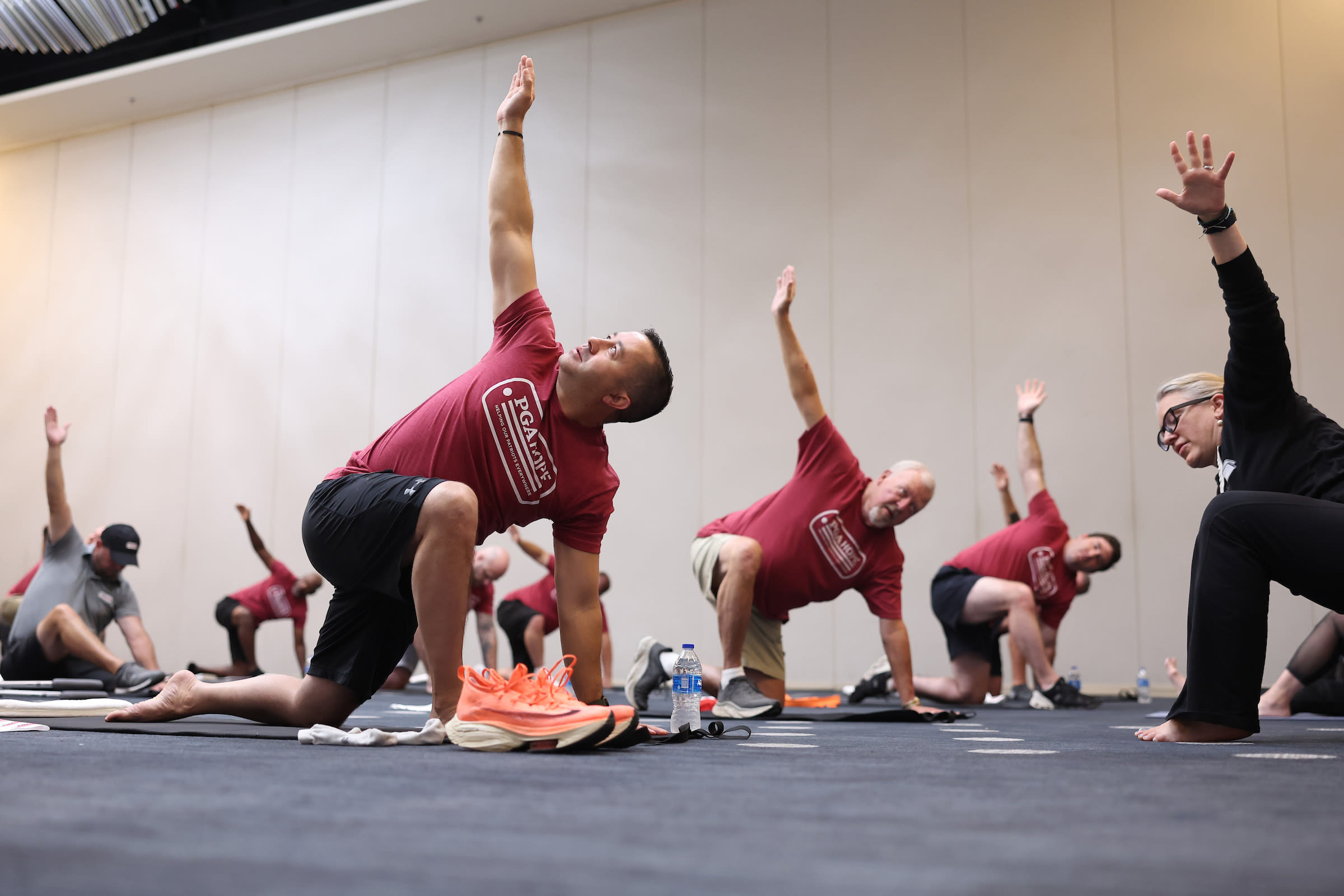
The 90/90 hip stretch should become part of your daily routine. Sit on the floor with one leg bent in front at 90 degrees and the other behind at 90 degrees. Sit up straight and hold for 45 seconds, then switch sides. Do this every day if you can, preferably while watching TV, so you’ll actually stick with it. Before each round or practice session, add hip circles to your warm-up: 10 slow circles with each leg, moving from your hip joint rather than your lower back. The world’s greatest stretch (yes, that’s its actual name) is also worth learning. From a push-up position, step your right foot outside your right hand, lower your left elbow toward the ground, then reach your right arm up. Hold for 5 seconds and repeat 5 times on each side.
Tip 3: Train Your Glutes
Your glutes are the engine room of your golf swing. They provide stability and power while helping you maintain posture from address to follow-through. Weak glutes? That’s probably why you’re losing your spine angle and catching the ball thin more often than you’d like.
Action Steps:
Begin each workout with glute bridges. Lie on your back with your feet flat on the floor, push through your heels to lift your hips, and squeeze at the top for 2 seconds. Do 3 sets of 15 reps. Once these feel easy, try single-leg bridges. Add lateral band walks by placing a resistance band above your knees, getting into a quarter-squat, and taking 10 steps to the right and 10 to the left. Your glutes should feel the burn. Do 3 sets before you hit the range. Finally, add step-ups with a rotation. Step onto a box or bench with your right leg, push through your heel to stand, and rotate your torso to the right at the top. This copies the weight shift and rotation in your swing. Do 3 sets of 10 on each side.
Tip 4: Build a Bulletproof Lower Back
Lower back pain tops the list of golf injuries, yet it’s almost entirely preventable. The solution isn’t endless crunches. What you need is stability and endurance in your core muscles, which means training them to resist movement rather than create it.
Action Steps:
Master the dead bug exercise first. Lie on your back with your arms up and knees bent at 90 degrees. Slowly lower your right arm over your head while straightening your left leg, keeping your lower back pressed flat to the floor. Return to the start and switch sides. Do 3 sets of 10 on each side, prioritizing control over speed. Bird dogs come next: get on your hands and knees, reach your right arm and left leg out simultaneously, hold for 3 seconds, then switch sides. This builds the spinal stability your swing demands. Do 3 sets of 10 per side. Anti-rotation holds round out the program. Use a resistance band or cable at chest height, hold it with both hands, and resist the pull, trying to rotate your body. Hold for 20 seconds, rest, and repeat 5 times on each side.
Tip 5: Don’t Forget Your Cardiovascular Base
Golf doesn’t feel like a cardio sport until you’re on hole 16, your focus is shot, and you’re making decisions you’ll regret. Walking 18 holes while staying sharp requires genuine endurance. Better cardiovascular conditioning means faster recovery between shots and clearer thinking when it matters most.
Action Steps:
Walk at least 9 holes twice a week. If you usually ride in a cart, this single change will transform both your conditioning and your scores. Add one 30-minute cardio session each week that gets your heart rate up: cycling, swimming, or a brisk walk with some hills. You’re not training for a marathon. You’re building a foundation that supports 4-5 hours on the course without falling apart. Once a week, try interval training. Walk or jog for 2 minutes at a comfortable pace, then push hard for 30 seconds. Repeat this 8-10 times. This emulates golf’s stop-and-go nature and develops the kind of fitness that actually translates to better play.
Golf fitness doesn’t require a fancy gym membership or hours of daily training. It requires consistency, smart exercise selection, and showing up regularly. Pick two or three of these tips, start this week, and watch what happens to your game.
PGA of America Golf Professional Brendon Elliott is an award-winning coach and golf writer. Read his recent “The Starter” on R.org and his stories on Athlon Sports. To stay updated on his latest work, sign up for his newsletter and visit OneMoreRollGolf.com.