Golf Travel
  Leaderboards
  Become a Member
  Shop
Shop  Trade In
 Course Spotlight
A Closer Look: Aronimink Golf Club & the 2026 PGA Championship
By Craig Dolch
Published on
Editor's note: This story originally appeared in the May 2026 issue of PGA Magazine.
The golf world will GET A MAJOR LOOK at Aronimink Golf Club during the 108th PGA Championship on May 11–17.
While it’s the first time Aronimink has hosted a men’s major (other than the 2003 Senior PGA Championship) since the 1962 PGA Championship, television viewers who tune in to CBS or ESPN and the large gallery will quickly recognize the style.
“It’s a classic northeast Donald Ross course,” says Jeff Kiddie, PGA, who had been the Head Professional at Aronimink for the last 17 years. “We have the authentic Donald Ross greens (that were built almost a century ago, in 1928).”
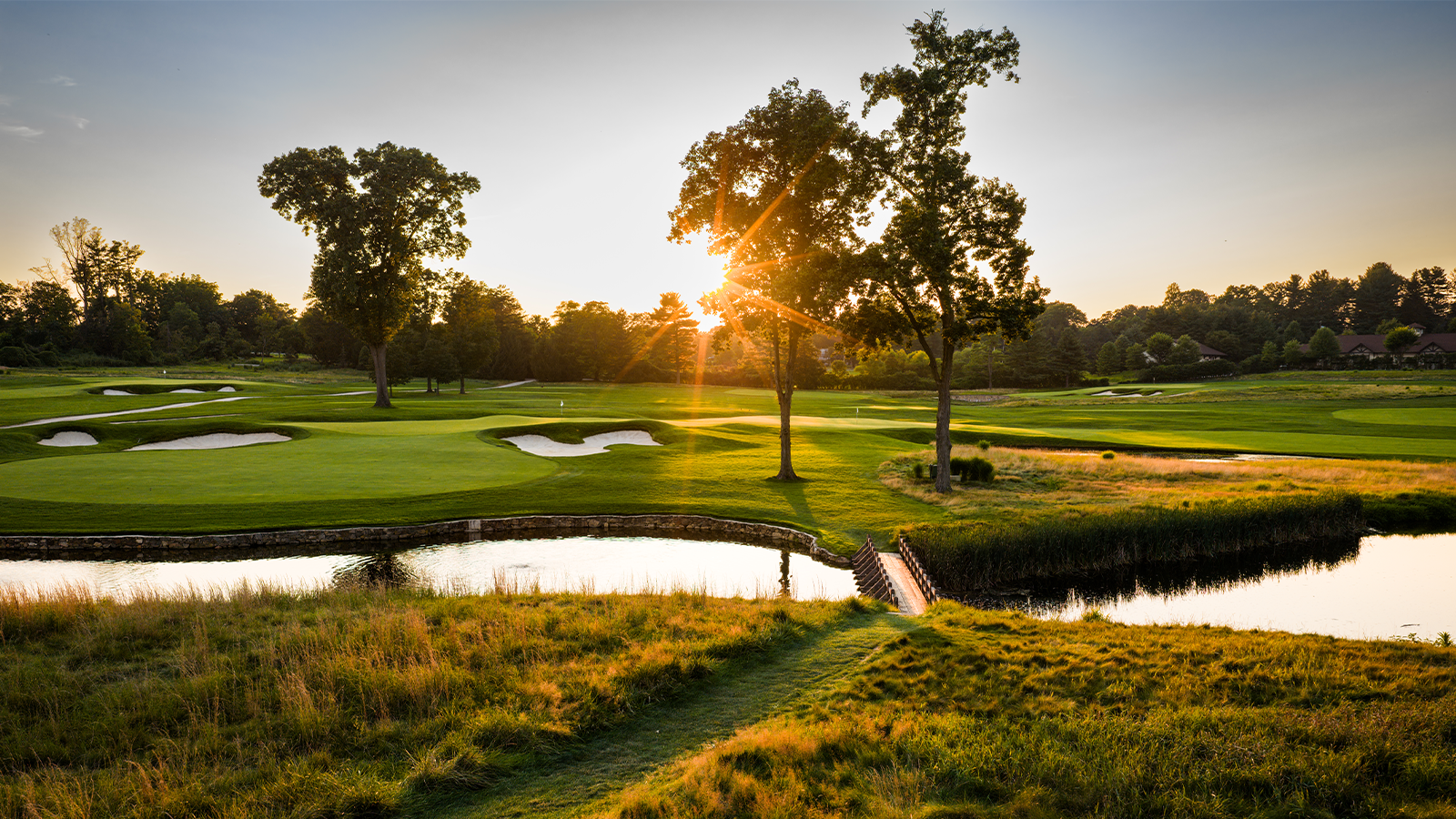
Many golf fans know the characteristics of a Donald Ross design: strategic use of the natural terrain, crowned turtleback greens and complex bunkering that makes any golfer think twice before pulling a club. But it’s Ross’ mastery on the greens that continue to confound the world’s greatest players, despite most of his 400-plus designs being built in an era of hickory shafts and gutta-percha golf balls. Even amateurs know: Don’t leave the ball above the hole on a Ross green.
In 1948, two decades after completion, Ross said: “I intended to make this my masterpiece, but not until today did I realize I built it better than I knew.”
Ross’ brilliance was still on display when Aronimink – named after the chief of the Lenape tribe who once occupied the small farmhouse being used as the original clubhouse – hosted its first men’s major. Gary Player won the 1962 PGA Championship by a shot over Bob Goalby. The winning score on the par-70 layout? Two-under.
When Aronimink officials approached the PGA of America about hosting another PGA Championship during the nation’s 250th birthday near Philadelphia, they knew the course had to get back to its roots. They needed to restore the course to Ross’ original design.
The process was started in 2003 when Ron Pritchard, a top architect from the Philadelphia area and the foremost authority on Ross’ design philosophy, completed a restoration that recaptured classic Ross features that had been diminished and lost over time. Based on Ross’ original drawings for the course, greens were restored to their original shapes and sizes, and his unique bunkering style was reestablished.
But Aronimink officials soon learned, when they watched 8mm films and aerial photos, the course Ross built wasn’t the same course he had originally drawn. Club officials reached out to golf course architect Gil Hanse, who lives in nearby Malvern, to return the course exactly to the way it was built.
It was a daunting ask, but Hanse took on the challenge in 2016. How could he not?
“Whenever you’re entrusted with a great old golf course like Aronimink, and then to have it be in your own hometown, it’s pretty exciting,” Hanse says. “We were excited, but we also knew what a great responsibility it was.”
The biggest change was more than doubling the number of bunkers, from 74 to 174, as Hanse took large greenside bunkers and turned them into smaller clusters, the way Ross had done. Hanse also expanded the greens by as much as 30 feet to provide more hole locations, widened several fairways, added length and removed some trees to give the course more of the original parkland feel.
The biggest change was more than doubling the number of bunkers, from 74 to 174, as Hanse took large greenside bunkers and turned them into smaller clusters, the way Ross had done. Hanse also expanded the greens by as much as 30 feet to provide more hole locations, widened several fairways, added length and removed some trees to give the course more of the original parkland feel.
“The restoration of that bunker style and those configurations is definitely the most dramatic part of what we did,” Hanse recalls. “It’s the visual, the character of these clusters and how they sit in the landscape, that stands out. Plus, you have a wonderful set of Ross greens.”
Hanse believes the end of each hole, the greens, is where the winner will be decided. Just another Ross tradition.
“I think it’s going to be somebody’s creativity around the greens, the ability to get up and down, that will be the critical part,” he says. “You’re going to miss greens, and it’s the scrambling ability that will be important. As with any Donald Ross course, being able to read those greens will be key because they have such significant contours, but also an amazing series of subtle breaks within them that will be crucial.”
Kiddie says the power game, which has become such an advantage in recent majors, won’t be as evident at Aronimink. His prediction is based on past results.
“If you look at players who have won here – Gary Player, Justin Rose (2010 AT&T National) and Keegan Bradley (2018 BMW Championship) – they always seem to be a well-rounded player,” Kiddie says. “They’re not the longest, but they’re long enough. They’re really good iron players and streaky putters.”
Kerry Haigh, the PGA of America Chief Championships Officer who sets up the PGA Championship courses, has spent the last few years adjusting Hanse’s work for the world’s best golfers. He has narrowed some of the fairways to create variety, and he has studied the most contoured greens to make sure the hole placements aren’t in dicey locations.
“It’s a wonderful course,” Haigh says. “It’s not overly long for today’s players – 7,400 yards, par 70. The greens will be the challenge. It should be a wonderful test.”
Per Haigh and Kiddie, more than 20 bunkers between the two sides of the fairway and around the green. Distance and spin control must be precise on the short uphill approach to the green.
Meanwhile, holes No. 8 and 10 will help determine who is crowned the 108th PGA Champion. No. 8 is a long downhill par 3 that can play to a variety of distances depending on where the hole is cut each day and which teeing area is selected. This puts a premium on club selection. A pond guards the front left of the green on No. 10, which slopes severely and is surrounded by thick rough, water and daunting collection areas.
As usual, Haigh will turn a short par 4 – the 385-yard 13th – into a drivable hole on the weekend. A new forward tee was built on the 13th to provide a risk-reward tee shot with out-of-bounds to the left of the well-contoured green.
But despite all the planning, what determines how the course plays championship week is Mother Nature. While Aronimink has been hit with a very harsh winter, like most Northeast courses, the growing season takes place in the spring.
Aronimink officials have taken note of the weather during mid-May the last two years. One was week-long rains, the other dry and warm.
“We’d like it to play fast and firm,” explains Kiddie, “but that won’t be up to us.”
He understands the pressure of Aronimink returning to a major-championship venue, especially for someone in the spotlight after being named the 2023 PGA of America Golf Professional of the Year. Kiddie and his staff have been working long hours to get every detail right.
“It’s almost a once-in-a-lifetime opportunity,” he says. “There hasn’t been a PGA Championship in Philadelphia since 1962. This is very personal for me.”
Despite being the host Head Professional, Kiddie says he plans to pull double duty by working as a PGA of America Rules official during the 2026 PGA Championship, as he’s done multiple times before. Kiddie says it has never been done by a host PGA of America Golf Professional, but he’s up for the challenge.
Just like Aronimink.
Just like Aronimink.