Golf Travel
  Leaderboards
  Become a Member
  Shop
Shop  Trade In
 Travel
Top Links Golf Courses You Can Actually Play in North America
By Adam Stanley
Published on
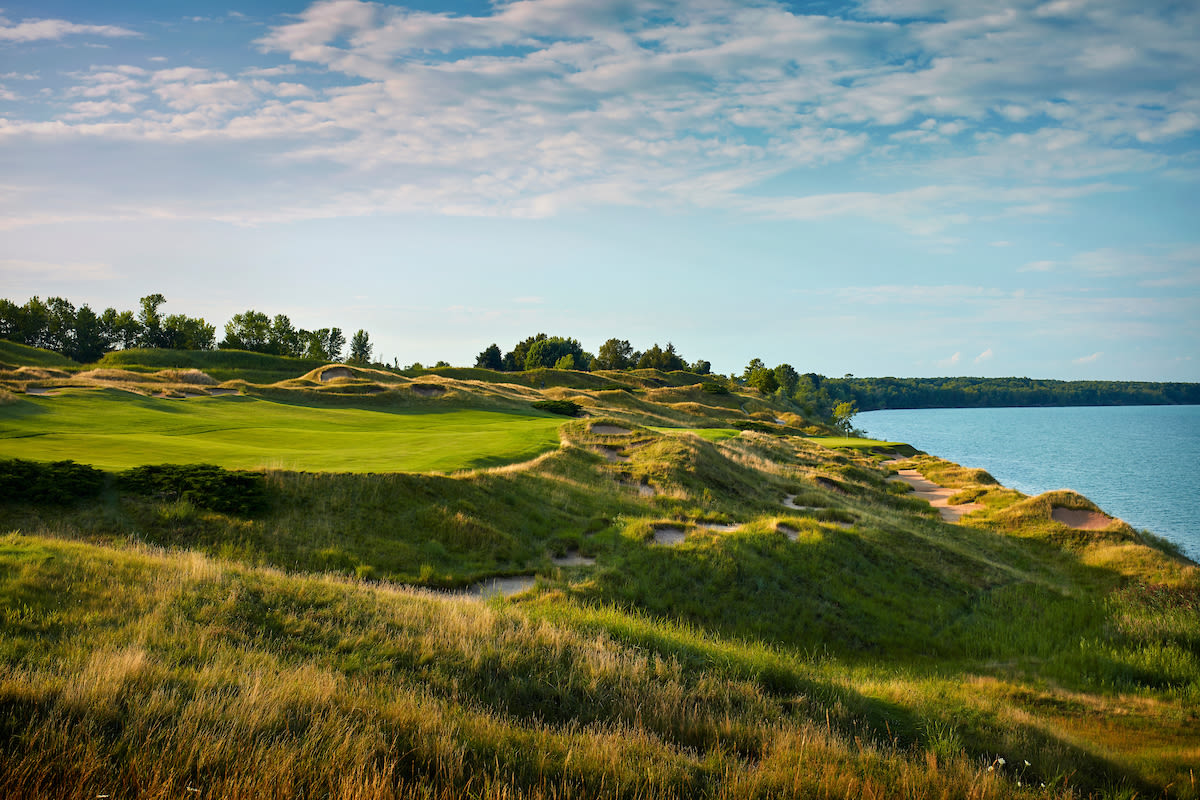
Hole Eleven of Whistling Straits Golf Course in Sheboygan, WI.Photo by Montana Pritchard/The PGA of America
The world's best golfers will return to Royal Birkdale in Merseyside, England, this week for another edition of The Open Championship.
Hosting The Open for the 11th time, Royal Birkdale offers one of the purest examples of classic links golf. Its holes weave naturally through towering sand dunes, with greens that reward well-struck approach shots while punishing misses with deep, unforgiving trouble. There are no gimmicks or hidden surprises, just a straightforward, strategic test where the course is laid out clearly in front of you, demanding quality execution.
Across the Atlantic, the definition of a links course remains slightly unconfirmed. For the most part, people do agree that links courses must be built on sandy terrain that ‘links’ land to the sea. That means, of course, many layouts officially known as ‘links’ are sea-adjacent with few trees, little fescue, and often feature holes cut through dunes.
In the United States, most of the golf is played inland. So, while there are most certainly links-style courses, there are very few actual links courses (by the loose definition above) in America.
That said, links golf continues to inspire creativity, shot-making, and fun across the country – all in some beautiful settings.
Here are a couple of notable linksy layouts in the United States. Who cares about the dictionary definition for now, because if it looks like a links and plays like a links, then we’re just fine with that.
BANDON DUNES (Old Macdonald, Pacific Dunes, Bandon Dunes)
Bandon Dunes is home to more than its fair share of links courses in the U.S. The triumvirate of courses on the Oregon coast have received a ton of accolades and a lot of praise since their opening. Bandon Dunes’ designer, David McLay Kidd, is Scottish and he knew upon arrival (Bandon Dunes was the first course at the iconic resort) that the site could have potential to create a true links. Pacific Dunes, designed by Tom Doak, takes full advantage of its location along the sea and boasts deep pot bunkers and rumpled fairways. Doak also designed Old Macdonald, which was his tribute to designer C.B. Macdonald. There are plenty of template holes (a Cape hole, a Biarritz, and more) that draw inspiration from the European links – that couldn’t be further away from the Pacific coast.
CABOT CAPE BRETON (Cabot Links)
Canadian designer Rod Whitman put his touch on this spectacular piece of property on the northern part of Cape Breton. It was the first ‘Cabot’ layout that has kickstarted the brand to new heights around the world. Every hole at Cabot Links has an ocean view, while the course is set on firm and fast, rugged linksland. The routing is certainly in the conversation for the best in Canada.
WHISTLING STRAITS
The host of multiple PGA Championships and a recent Ryder Cup, the Straits Course at Whistling Straits in Wisconsin is a Pete Dye design that, according to Golf Digest was his best attempt at crafting an imitation Ballybunion on the shores of Lake Michigan. There are more than 1,000 bunkers and the layout features imported fescue grasses and rolling dunes, with eight holes along the coastline.
KIAWAH ISLAND (Ocean Course)
Another multi-time PGA Championship venue – and Ryder Cup host – the Ocean Course at Kiawah Island along the South Carolinian coast is another Pete Dye links-inspired design with 10 holes along the water. Dye’s design at Kiawah features waste bunkers, deep pot bunkers, plenty of tumbling fairways and naturally flows through the windswept dunes.
ARCADIA BLUFFS
Opened in 1999, the Bluffs Course at Arcadia Bluffs is on a windswept site along 3,000 feet of Lake Michigan shoreline. Fairways are wide and built upon sandy soil, and the layout boasts sod-walled bunkers, spacious greens, and plenty of native grasses. The resort – which celebrated its 25th year in 2024 – also features another 18-hole championship layout, (the South Course) and coming soon, a short course. To add to the feeling of a Scottish links, there is a bagpiper who plays multiple times per week through the summertime.